


Page 27 - ISAKOS Newsletter 2016 Volume 1
P. 27
Soft Tissue Balancing in Total Knee Arthroplasty
Tomoyuki Matsumoto, MD, PhD Hirotsugu Muratsu, MD, PhD Kobe University Graduate School of Medicine, Kobe, JAPAN
Ryosuke Kuroda, MD, PhD
Masahiro Kurosaka MD, PhD
Steel Memorial Hirohata Hospital, Himeji, JAPAN
Introduction
Total knee arthroplasty (TKA) is a well-established procedure, which generally results in pain relief, improved physical function, and a high level of patient satisfaction. However, knee instability following primary TKA is considered an important factor for early TKA failure, as shown in the registry data. Fehring et al studied 279 revision surgeries within 5 years of their index arthroplasty, and reported 74 revision cases (27%) caused by instability. In a retrospective study of revision surgery, Sharkey et al reported instability in 21.2% of their early revision knee arthroplasty failures. They concluded that the instability might be due to inadequate correction of soft tissue imbalances in both the sagittal and coronal planes. As a result, soft tissue balancing has been recognized as an essential surgical intervention for improving the outcomes of TKA.
Intraoperative assessment of soft tissue balance remains difficult, and management is left much to the surgeon’s subjective feel and experience. Whereas several quantitative measurement methods using tensors or balancers were traditionally reported, measurement was performed under unphysiological conditions after TKA; including an assessment of bone cut surfaces with patello-femoral (PF) joint eversion.
In this article, an offset-type tensor device in which soft tissue balance can be assessed throughout the range of motion with a repaired PF joint and a femoral component in place, is discussed and the clinical value of using the system is also highlighted.
Offset-type Tensor
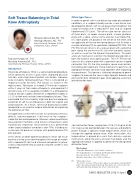
In order to permit soft tissue balancing under physiological conditions, in a surgeon-friendly manner, a new tensor was developed to obtain soft tissue balancing throughout the range of motion with a reduced PF joint and an aligned tibiofemoral (TF) joint. The offset type tensor consists of three parts: an upper seesaw plate, a lower platform plate with a spike, and an extra-articular main body (Fig. 01). Both plates are placed at the center of the knee, and we apply one of the two tensioning devices that fit either a cruciate-retaining (CR) or a posterior-stabilized (PS) TKA. The PS TKA tensor consists of a seesaw plate with a proximal post along the center that fits the inter-condylar space, as well as a cam for the femoral trial prosthesis. This post and cam mechanism controls the tibiofemoral position in both the coronal and sagittal planes. The CR TKA tensor consists of a seesaw plate with a proximal convex shaped centralizer that fits the inter-condylar space and controls the coronal joint alignment. These mechanisms permit us to reproduce the joint constraint and alignment after implanting the prostheses. This device is ultimately designed to permit surgeons to measure the varus/valgus ligament balance and joint center / joint component gap, while applying a constant joint distraction force.
01
Joint distraction forces ranging from 30 lb (13.6 kg) to 80 lb (36.3 kg) can be exerted between the seesaw and platform plates through a specially made torque driver, which can change the applied torque value. After sterilization, this torque driver is placed on a rack that contains a pinion mechanism along the extra-articular main body, and the appropriate torque is applied to generate the designated distraction force.
Disclosures:
Tomoyuki Matsumoto - No Conflict of Interest
Hirotsugu Muratsu - Consulting and Royalty Zimmer Biomet Ryosuke Kuroda - No Conflict of Interest
Masahiro Kurosaka - No Conflict of Interest
01 Offset-type tensor
The tensor consists of three parts: upper seesaw plate, lower platform plate, and extra-articular main body. Two plates are connected to the extra-articular main body by the offset connection arm.
CURRENT CONCEPTS
ISAKOS NEWSLETTER 2016: Volume I 25


