


Page 26 - ISAKOS Newsletter 2016 Volume 1
P. 26
CURRENT CONCEPTS
Elbow Injuries in the Throwing Athlete: Location, Location, Location!
Treatment Strategies: Posterior Elbow Pain
Valgus Extension Overload Syndrome
Valgus extension overload syndrome (VEOS) is a common malady in throwing athletes. VEOS is thought to be secondary to posteromedial impingement secondary to repetitive valgus microtrauma and the subsequent formation of posteromedial osteophytes. Osteophyte formation results in posterior pain with repetitive locking and catching in extension and is frequently symptomatic in the late acceleration and follow-through throwing phases. VEOS may be associated with UCL injury or capitellar OCD.
Nonoperative treatment follows a standard approach of rest, ice and nonsteroidal anti-inflammatory drugs. Range of motion and strengthening exercises are subsequently resumed following symptom improvement. Operative treatment is indicated after unsuccessful nonoperative management or in throwing athletes with symptomatic osteophytes. Arthroscopic debridement and osteophyte excision is primarily used. Athletes should be aware of the risk of recurrence and intraoperative risk of ulnar nerve injury. Concomitant pathology should also be addressed at the time of surgery. Rest and rehabilitation is dependent on the extent of the operation.
Olecranon Stress Fracture
Olecranon stress fractures may develop from repetitive microtrauma, osteophyte impingement, or from tensile failure from the triceps insertion. Pain is localized to the posterolateral or posteromedial olecranon. As with most pathology in the throwing elbow, the pain is usually insidious in onset and progresses over time.
Nonoperative management with rest and no throwing is initially attempted. Brief immobilization and initial limited extension may relieve symptoms and allow for healing. Operative intervention is recommended for complete fractures. Two mainstays of operative management include compressive cannulated screw fixation and plate osteosynthesis. Range of motion exercises are generally commenced early to prevent elbow stiffness; however in nonoperative treatment extension may be initially limited. Gradual return to throwing is initiated at approximately 6-8 weeks for either non-operative or operative treatment.
04
Summary
The diagnosis of elbow pain in the throwing athlete is principally determined by the location and timing of the pain during throwing. A thorough history of the pain when throwing can help elucidate chronic overuse injuries. The differential is then quickly reduced based on where the elbow is tender and the location of pain with range of motion. A limited and specific imaging modality can then confirm the diagnosis. Following treatment it is important to be cautious in the rehabilitation process to prevent the recurrence of overuse injuries. When examining the elbow in the throwing athlete, remember: Location, Location, Location!
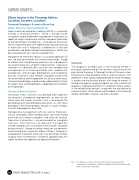
04 A complete olecranon stress fracture treated operatively with cannulated screw fixation. Lateral radiographs taken immediately and at two months post-operative.
24 ISAKOS NEWSLETTER 2016: Volume I


