


Page 29 -
P. 29
Clinical Studies
There is a paucity of literature on the effect of femoral tunnel positioning and ACL graft failure
The Danish Registry has shown a higher failure rate for patients undergoing an ‘anatomical’ ACL reconstruction principles by which the anteromedial portal is used for identification and drilling of femoral ACL insertion. In 9239 patients followed for 4 years the revision rate for anteromedial drilling was 5.2% compared with 3.2% when trans tibial drilling was performed.
Recent unpublished data from the Danish ACL registry have demonstrated that the initial increase in revision rate found when anatomical ACL reconstruction techniques were introduced has improved. However the transtibial technique continues to demonstrate a decreased revision rate compared with recent ‘anatomic’ AM portal technique ACL reconstructions.
Taken together, this data suggests that it may be strategically 04
CURRENT CONCEPTS
02
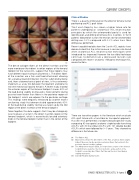
The dense collagen fibers of the direct insertion and the more membrane-like indirect insertion regions of the femoral footprint of the native ACL suggest that these regions may have different load sharing characteristics. The direct fibers of the insertion are a firm and fixed attachment allowing for a gradual load distribution into the subchondral bone and, from a biomechanical point of view, is thus extremely important as a key link between the ligament and bone to transmit mechanical load to the joint. A recent study showed the anterior region of the femoral footprint shares 80% of the load during stability testing and is more isometric during passive knee flexion than fibers in the posterior region of the footprint, which are adjacent to the posterior cartilage This findings were elegantly reinforced by another recent sectioning study that demonstrated approximately 80% of the load during stability testing was taken up by the AM region of the direct insertion of the femoral footprint.
wise to place a tunnel in the direct insertion region of the femoral footprint, which is eccentrically located anteriorly (high) in the femoral footprint rather than in the center of the footprint.
There are two other papers in the literature which evaluate ACL graft failure with a transtibial or transportal approach. Hussein et al performed a randomised prospective study comparing 80 transportal anatomic single bundle hamstring ACLR’s with 80 transtibial ACLR’s with 141 double bundle ACLR’s which were followed for 3–5 years. They showed no difference in the failure rate.
01 The Ribbon ACL
02 Black arrow shows the direct fibers of the ACL at various flexion angles.
Indirect fibers are fan like posterior extension fibers that extend to the
posterior femoral condyle cartilage.
03 The AM position may be IDEAL as it represents a region of the femoral
footprint that is anatomic, the most isometric, and a portion of the footprint covered by direct fibers that take up the most load during stability maneuvers.
04 Dansidh Registry Surivial Curve
03
ISAKOS NEWSLETTER 2015: Volume II 27


