


Page 34 - ISAKOS Newsletter 2016 Volume 1
P. 34
APPROVED COURSE REPORTS
International Elbow Course
3–5 December, 2015
Arezzo, Italy
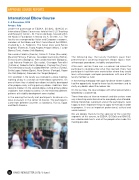
Under the patronage of ESSKA, SICSeG, ISAKOS an International Elbow Course was held at the ICLO Teaching and Research Center – St. Francis de Sales, housed within the Nicola’s Foundation in Arezzo (via A. Einstein, 12). The faculty was composed by Italian and European surgeons, members of the Elbow and Wrist Committee of the ESSKA, chaired by L. A. Pederzini. The Italian ones were Renzo Angeloni (Florence), Paolo Angelo Arrigoni (Milan), Davide Blonna (Turin), Andrea Celli (Modena),
Alessandra Colozza (Faenza), Felice Di Palma (Sassuolo), Maurizio Fontana (Faenza), Giuseppe Giannicola (Rome), Enrico Guerra (Bologna), Alessandro Marinelli (Bologna), Luigi Adriano Pederzini (Sassuolo), Giuseppe Porcellini (Cattolica), Roberto Rotini (Bologna), Pierluigi Tos (Turin). The international faculty included Mehmet Demirtas (Turkey), Emilio Lopez Vidriero (Spain), Nuno Sevivas (Portugal), Roger Van Riet (Belgium), Alexander Van Tongel (Belgium).
On December 3, the faculty was involved in a close meeting, working all day in a section on three elbow specimens. On one of them they studied how elbow instability developed after progressively cutting primary elbow stabilizers from lateral to medial. On the second elbow, cutting primary elbow stabilizers from medial to lateral. On the third limb different patterns of instability development were studied.
In the evening the faculty met participants for dinner at a local restaurant in the center of Arezzo. The participants came from different Countries as Giordania, Russia, Egypt and South America.
The following day, the faculty members gave their presentations covering important elbow topics from arthroscopic procedures, instability and prosthesis.
After each section there was a cadaver lab where the participants could practice what they learned. Every two participants had their own workstation where they could learn arthroscopic and open procedures with one of the faculty member as tutor.
In the evening everybody met again for dinner where students had the opportunity to get to know faculty members and to clarify any doubts about the cadaver lab.
On the last day, the course began with other presentations followed by a cadaver lab.
These three days of intense research and discussions were very interesting and informative for everybody who attended. Strong friendships were built and all the participants were happy to learn important things to apply to their job in order to progress. It was an important professional, cultural and social moment.
We are deeply thankful to the sponsor of the scientific segments of this course, to ESSKA, SICSeG and ISAKOS, our unbelievable hosts and all the people who made this meeting possible.
32 ISAKOS NEWSLETTER 2016: Volume I


