


Page 44 -
P. 44
WORST CASE SCENARIO
Multi-ligament Injured/Dislocated Knee: Could Amputation have been Avoided?
Bruce A. Levy, MD
Professor
Department of Orthopedic Surgery Mayo Clinic
Rochester, MN, USA
This 16 year-old high school football player sustained a contact injury to his left knee while being tackled. He was unable to move his knee because of pain and on-field assessment demonstrated intact skin with no obvious deformity and a markedly positive Lachman exam consistent with complete anterior cruciate ligament (ACL) disruption. He was carried off the field and taken to the local emergency department (ED).
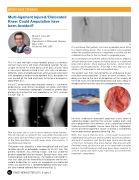
Initial ED examination documented strong 2+ symmetric pedal pulses and normal neurologic sensation and motor function. Presentation radiographs showed an anterior tibial plateau rim fracture that was reported as an “ACL avulsion fracture” (Fig. 1).
02
It is well know that patients can have a palpable pulse distal to a major arterial lesion. This is an excellent case example where the popliteal artery was completely occluded but the collateral blood flow to the foot lead to a palpable pulse.
At our institution we perform ankle brachial indices (ABI) for all high-energy knee trauma including know or suspected knee dislocations, tibial plateau fractures, distal femur factures and floating knees. If the ABI is less than 0.9, we obtain a CT angiogram to rule out popliteal injury.
The patient was then transferred by air ambulance to our institution and arrived after 12 hours of warm ischemia. This delay was due to the lack of recognition of the severity of the knee injury (missed knee dislocation) and also a delay in recognizing the vascular injury (missed popliteal artery injury).
03a 03b
He then underwent emergent popliteal artery reverse saphenous bypass graft by the vascular surgery team, and four-compartment fasciotomies and a spanning external fixator by our orthopedic trauma team (Fig 3a). Exploration of the posterior popliteal space showed a completely transected common peroneal nerve (Fig. 3b).
With this nerve transection, a thorough neurologic examination would have demonstrated absent dorsiflexion and lack of sensation over the first web space and dorsum of the foot. Knowing that knee injuries that present with Peroneal nerve dysfunction are associated with vascular injuries, the ED medical staff may have been clued in to a more significant knee injury had they discovered the neurologic compromise.
01
Rim fractures are a clue to more ominous knee injuries. The rim fracture occurred in this case when the knee joint dislocated and the femur rolled over the anterior aspect of the tibia and then, as with many knee dislocations, it spontaneously reduced.
The patient was placed in a knee immobilizer and was told to follow up with an orthopedic surgeon for his ACL tear. The patient, however, was writhing in pain, and was unable to be discharged because of the pain. Several hours later, with increasing pain and paresthesias, the medical staff noted his skin was cool, pulses were difficult to palpate and he was unable to dorsiflex his ankle. An angiogram was obtained which was positive for a complete popliteal artery occlusion but also showed collateral flow to the foot (Fig. 2).
42 ISAKOS NEWSLETTER 2015: Volume II


